Introduction
Hospitals are among the most important institutions in modern society. They provide medical care, save lives, and promote public health. Today, hospitals are equipped with advanced technology, trained doctors, nurses, laboratories, and emergency services. However, hospitals did not always look like they do today. The history goes back thousands of years to ancient civilizations, where people received treatment in temples, healing centers, and military camps. Over time, developed into organized institutions that offered professional medical care to everyone. The evolution of reflects humanity’s continuous efforts to improve health, reduce suffering, and increase life expectancy.
Early Healing Centers
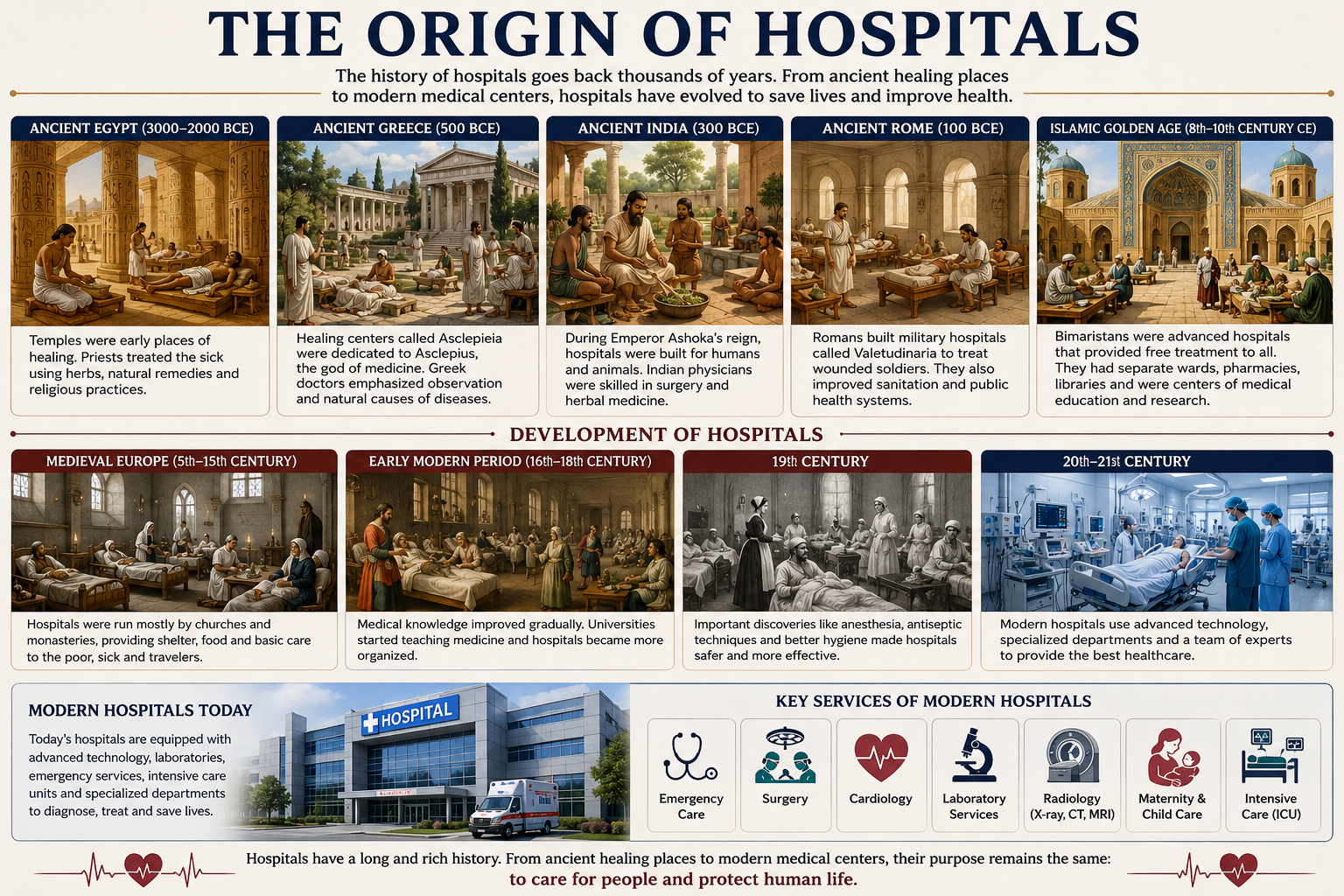
In Ancient Egypt, temples served as places where the sick could receive care. Egyptian physicians were highly skilled in treating wounds, broken bones, and various diseases. They also recorded medical knowledge on papyrus scrolls, which became some of the world’s earliest medical documents.
In Mesopotamia, medical treatment combined herbal medicine with religious rituals. Doctors carefully observed patients and used their knowledge to diagnose illnesses. Although medical science was still developing, these early civilizations laid the foundation for future healthcare systems.
Hospitals in Ancient India
Ancient India made significant contributions to the development of hospitals and medicine. Around the 3rd century BCE, during the reign of Emperor Ashoka, hospitals were established to provide treatment for both humans and animals. Ashoka believed that healthcare was the responsibility of the state and encouraged the construction of medical centers throughout his empire.
Indian physicians became experts in surgery, herbal medicine, and disease prevention. Medical knowledge was recorded in important texts such as the Charaka Samhita and the Sushruta Samhita, which described surgical techniques, medicines, and methods of patient care. These texts influenced medical practice for centuries.
Hospitals in Ancient Greece
The ancient Greeks greatly advanced medical science. Around 500 BCE, healing centers known as Asclepieia were built in honor of Asclepius, the Greek god of medicine. These centers welcomed patients seeking treatment for various illnesses.
Greek physicians emphasized careful observation and diagnosis rather than relying only on religious beliefs. The famous physician Hippocrates, often called the Father of Medicine, introduced the idea that diseases have natural causes rather than supernatural ones. His teachings encouraged doctors to study symptoms carefully and treat patients using scientific methods.
Hospitals in Ancient Rome
The Romans further improved healthcare by establishing hospitals for soldiers. Around 100 BCE, they built military hospitals called Valetudinaria inside army camps. These hospitals provided treatment for wounded soldiers and helped them recover quickly so they could return to military service.
Roman engineers also improved sanitation by constructing aqueducts, sewage systems, and public baths. Clean water and better hygiene reduced the spread of diseases and improved public health. Although civilian hospitals were still uncommon, Roman medical practices contributed significantly to healthcare development.
The Rise of Hospitals During the Islamic Golden Age
One of the greatest milestones in hospital history occurred during the Islamic Golden Age, between the 8th and 10th centuries CE. Muslim scholars and rulers established advanced hospitals known as Bimaristans in cities such as Baghdad, Damascus, Cairo, and Cordoba.
These hospitals were among the first institutions to resemble modern hospitals. They provided free treatment regardless of religion, nationality, or social status. Patients received professional medical care from trained physicians, and hospitals included pharmacies, libraries, classrooms, and separate wards for different diseases.
Doctors carefully examined patients, maintained medical records, and trained medical students. Mental health patients also received specialized care, which was unusual for that period. These hospitals became centers of education, research, and public healthcare, influencing hospital systems throughout Europe and Asia.
Medieval Europe
During the Middle Ages, hospitals in Europe were often connected to churches and monasteries. Religious organizations established hospitals to care for the poor, elderly, travelers, and sick. Although these hospitals offered shelter, food, and basic treatment, medical knowledge was still limited.
By the late medieval period, European universities began teaching medicine more systematically. This gradually improved the quality of medical care and encouraged the growth of professional hospitals.
see over other postsThe History of the Car
The Development
The 18th and 19th centuries marked a major transformation in healthcare. Scientific discoveries led to significant improvements in hospital care. Doctors learned more about anatomy, surgery, and infectious diseases.
One of the most important developments was the introduction of anesthesia, which allowed surgeons to perform operations without causing severe pain. Another major breakthrough came when Joseph Lister introduced antiseptic surgical techniques, greatly reducing infections after surgery.
During the Crimean War, Florence Nightingale transformed nursing by promoting cleanliness, proper ventilation, and organized patient care. Her work greatly reduced hospital death rates and established nursing as a respected profession.
Hospitals also began using X-rays, laboratory testing, vaccination programs, and improved surgical equipment. These advances made hospitals safer and more effective than ever before.
the 20th and 21st Centuries
Modern hospitals are highly advanced healthcare institutions. They contain specialized departments such as emergency medicine, surgery, cardiology, neurology, pediatrics, oncology, radiology, and intensive care units (ICUs). Doctors and nurses work together with pharmacists, laboratory technicians, physiotherapists, and other healthcare professionals to provide comprehensive medical care.
Technological innovations such as MRI scanners, CT scans, robotic surgery, organ transplantation, artificial intelligence, and telemedicine have revolutionized healthcare. Hospitals now diagnose diseases earlier, perform complex surgeries, and provide better treatment for patients than ever before.
During global health emergencies such as the COVID-19 pandemic, hospitals played a vital role in saving lives, conducting research, and developing vaccines.
Importance
Hospitals are essential for every society. They provide emergency treatment, perform surgeries, diagnose diseases, deliver babies, care for injured patients, and educate future healthcare professionals. Hospitals also conduct medical research, develop new treatments, and promote disease prevention through vaccination and public health programs.
Without hospitals, it would be much more difficult to control diseases and respond to medical emergencies. They remain one of the greatest achievements of human civilization.
Conclusion
The history of hospitals spans more than 4,000 years. From the healing temples of Ancient Egypt and Greece to the military hospitals of Rome and the advanced Bimaristans of the Islamic Golden Age, hospitals have continuously evolved to meet human needs. Scientific discoveries, medical education, and technological progress transformed simple healing centers into the modern hospitals we know today. Hospitals continue to save millions of lives every year and remain essential institutions for healthcare, research, education, and public well-being. Their development reflects humanity’s ongoing commitment to improving health and caring for those in need.
see our lates post:The History of the Cart